Comparison of RA 10121 and RA 12287
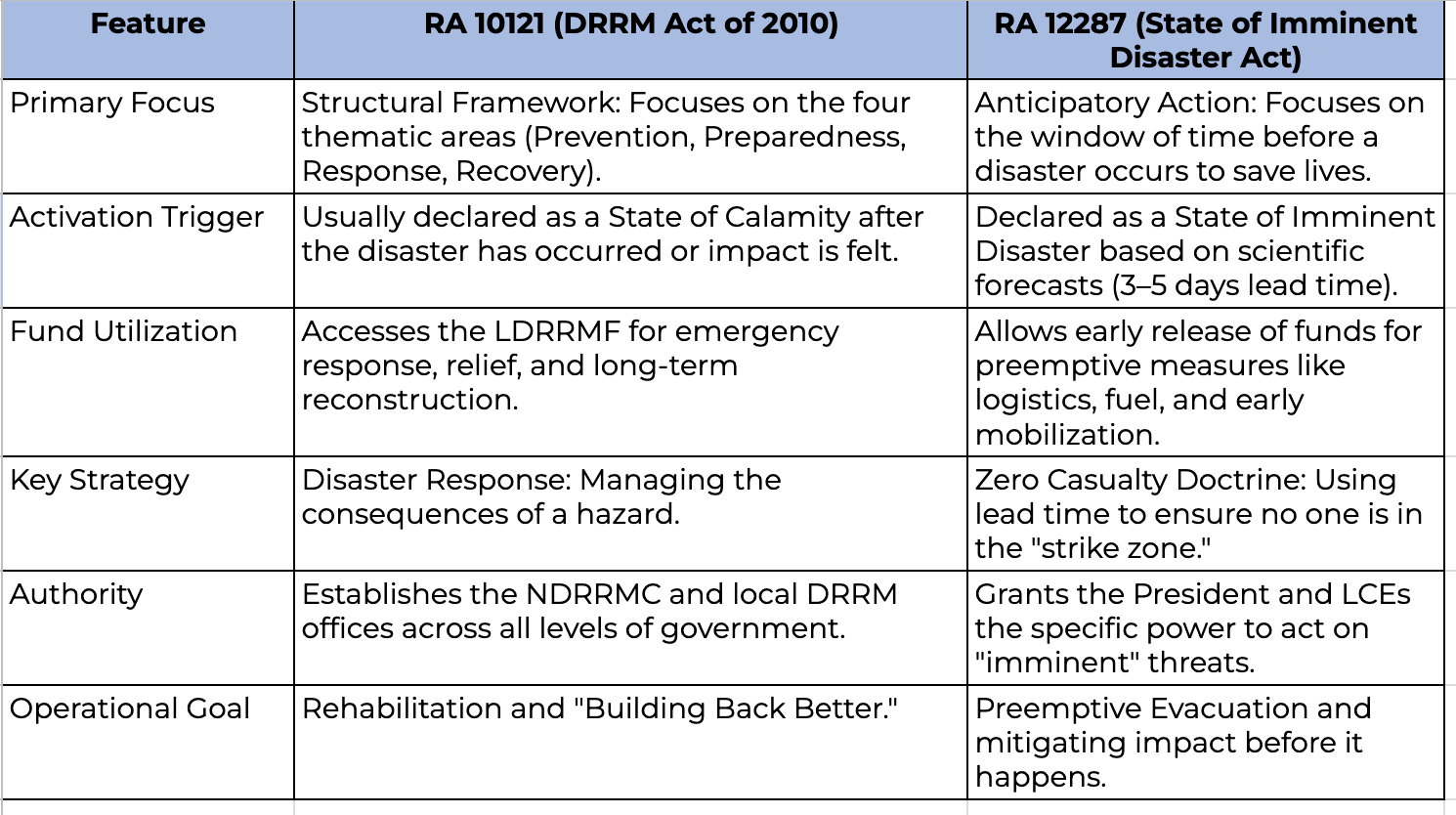
In a nation ranked among the most disaster-prone globally, the Philippines has moved beyond the era of "disaster response" into a sophisticated age of Integrated Risk Management (IRM). By aligning international standards like ISO with localized mandates such as RA 10121 and the groundbreaking RA 12287, the country is setting a global benchmark for surviving and thriving amidst uncertainty.
The foundation of the Philippine disaster strategy is Republic Act No. 10121 (The DRRM Act of 2010). This law decentralized disaster management, empowering the National Disaster Risk Reduction and Management Council (NDRRMC) to oversee four thematic areas: Prevention, Preparedness, Response, and Rehabilitation.
Under this framework, risk is no longer managed as an isolated event but as a continuous cycle.
Signed in September 2025, Republic Act No. 12287 institutionalizes the "Zero Casualty Doctrine." This law allows the President or Local Chief Executives to declare a State of Imminent Disaster based on scientific forecasts rather than waiting for actual impact.
Anticipatory Action: Agencies can now legally mobilize funds and resources 3 to 5 days before a hazard strikes.
Preemptive Evacuation: Provides the legal teeth to move populations out of harm's way, shifting the focus from "search and rescue" to "preemptive safety."
Comparison of RA 10121 and RA 12287
While RA 12287 protects the public, the Public Service Continuity Plan (PSCP) Version 2 protects the government’s ability to function. Guided by DILG MC 2020-161, all LGUs and government agencies must establish a PSCP to ensure that "non-negotiable" services—like healthcare, peace and order, and relief distribution—remain operational during a crisis.
Key components of the Version 2 Guidelines include:
Critical Function Identification: Determining which services must never stop.
Resource Mapping: Identifying alternative workspaces and digital backups.
Succession Planning: Ensuring a clear line of command if leadership is incapacitated.
Resilience extends to the marketplace. The Department of Trade and Industry (DTI) ensures that the "Minimum Initial Service Level" for businesses is maintained. By protecting supply chains and stabilizing prices during declared states of imminent disaster, the DTI prevents economic collapse following natural calamities.
To achieve true resilience, Philippine organizations are increasingly aligning their DRRM efforts with global standards:
ISO 31000: For high-level risk governance.
ISO 22301: For business continuity and recovery controls.
ISO 45001: For ensuring worker safety during emergency deployments.
The Philippine resilience model is no longer just about enduring a storm; it is about the Integrated Risk Management of climate change, ecosystem health, and service continuity. With the enactment of RA 12287 and the refinement of the PSCP, the Philippines is transitioning into a proactive state where data, law, and strategy converge to protect every Filipino life.
DILG. (2020). Adoption of the safety seal certification program (Memorandum Circular No. 2020-161). Department of the Interior and Local Government.
Manila Standard Business. (2025, September 29). Salceda: Imminent disaster life-saving doctrine pioneered in Albay now a law. Manila Standard.
NDRRMC. (2024). Public Service Continuity Plan (PSCP) Guidebook Version 2. Office of Civil Defense.
Official Gazette. (2010). Republic Act No. 10121: The Philippine DRRM Act. Government of the Philippines.
Official Gazette. (2025). Republic Act No. 12287: Declaration of State of Imminent Disaster Act. Government of the Philippines.