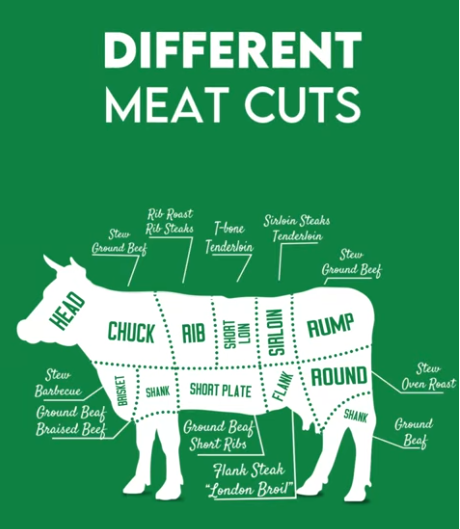
Knowing the origin of the meat cut gives you proper insight as to the cooking method that works best for that cut.
If you need to revisit Cooking Methods, here's the link:
From the front of the animal.
Chuck Roast. This is a shoulder cut. Not tender as it is an exercised muscle.
Includes chuck steaks and is often ground for ground beef.
Also for this area is the 7-bone Roast. The 7 bone itself is a cross section of the scapula (shoulder blade).
Generally stew meat is cut from this area.
These cuts are slow cooked and due to the connective tissue will provide a deep flavor. Best for braising or stewing.
Moving down you have the Brisket. Can be roasted alone, stewed, barbecued or braised. May be grilled (Indirect heat) in aluminum foil at 250-275° with the foil removed for the last 45 minutes
Flavorful, but requires slow indirect heat 250-275° to become tender. Generally braised in a lidded roasting pan with the lid removed the last 45 minutes to brown.
Just behind the brisket are the Leg Shanks. Because this is from the leg, it is a highly exercised muscle and can only be cooked with a moist heat method such as braising.
The Short Plate will contain some rib tips as it is from the underside of the cow's stomach. This is quite fatty, but flavorful. The source of Short Ribs and ground beef. Best if braised, but with the fat cap removed they can be grilled with slow heat.
The Flank. Provides Flank Steak and London Broil. Can be grilled or broiled. These items are served rare and should be cut against the grain to mimic tenderness.
Next is the Round, the lower portion of the hind quarters. The round is divided into cuts including the Eye of Round, Bottom Round, and Top Round, with or without the "round" bone . This is exercised muscle and best prepared using moist heat(braising).
Above the Round is the Rump. This includes the Sirloin, Rump Roast, Tri-tip, Full Sirloin, Top Side and Eye of the Rump( cross-section of 5 different muscles and most tender). Steaks can be grilled but, thicker meats do best braised.
The Sirloin. The top sirloin steak is the most tender and flavorful of the sirloin cuts. It’s taken from the upper portion of the sirloin, close to the short loin. This steak is well-marbled, making it juicy and flavorful.
The bottom sirloin is divided into several cuts, including the Tri-Tip and the Sirloin Tip.
This cut is sometimes referred to as a boneless sirloin strip or just strip steak.
The center-cut sirloin steak is obtained from the center of the sirloin section, making it more uniform in shape and size. It’s a versatile steak suitable for grilling, pan-searing, or broiling.
Flat-Bone Sirloin Steak
As the name suggests, this sirloin steak is cut with a portion of the flat bone still attached, which can add extra flavor. It’s often used for broiling or grilling. The bone can help retain moisture and flavor during cooking.
Moving to the Short Loin. Porterhouse, New York Strip, T-Bone, Top Loin and Tenderloin. These are less exercised portions of muscle, thus more tender. Often marbled well. Great for grilling, broiling and dry heat methods.
Lastly, Rib. Rib Roast, Rib Steaks, Prime Rib, Standing Rib Roast and of course, Ribs. Grilling, Roasting, Braising, and Combination cooking methods.